Hydration advice is noisy—your workday isn’t
You’ve heard every rule: eight glasses, “just drink when you’re thirsty,” add electrolytes, don’t count coffee. Then you look at your calendar—two back-to-back meetings, a long commute, and a laptop that keeps you glued to the chair.
That’s the real constraint. You don’t need perfect advice; you need something that fits your day without constant refills or extra bathroom trips. And you need it to work even when coffee becomes breakfast and “later” turns into 3 p.m.
The fix starts smaller than a new target. It starts by noticing the few moments your body reliably signals it’s running low.
Notice your personal “dry moments” before you change anything
Those signals usually show up at the same times: you sit down after the commute, you finish a long call, you finally look up from a deadline and realize your mouth feels dry. Most people miss these moments because they’re subtle, and because you’re busy doing something else.
For two workdays, don’t “fix” anything. Just log your dry moments in the notes app you already use. Keep it simple: time, what you were doing, and one body cue (dry mouth, scratchy throat, mild headache, cranky focus, or a sudden urge to raid the snack drawer). Add one bathroom clue: when you do go, is your urine pale yellow, or is it getting darker by mid-afternoon?
You’re not hunting perfection. You’re looking for patterns you can build around—because the easiest hydration plan is the one that matches your natural low points, not a number on a bottle.
Are you underhydrated—or just running on caffeine and distractions?

Once you can spot your low points, the tricky part is naming the cause. A dry mouth at 11 a.m. might mean you need water—or it might mean you’ve had two coffees, talked for an hour, and haven’t taken a real break.
A quick gut-check helps. If your urine is getting darker and you haven’t peed in hours, you’re probably behind on fluids. If you’re peeing normally and it’s mostly pale yellow, but you feel “off,” look at what’s driving it: caffeine on an empty stomach, long stretches without standing up, or stress that keeps you breathing shallow and forgetting to blink. Those can feel like dehydration because they show up as headache, foggy focus, and snack cravings.
Chasing every dip with more water can mean more bathroom trips without better energy. The goal is to match the fix to the signal—then build a drinking rhythm that doesn’t fall apart when meetings stack up.
A drinking rhythm that survives back-to-back meetings
When meetings stack, most people either sip constantly (and spend the afternoon scouting bathrooms) or forget entirely and try to “catch up” at 3 p.m. The steadier option is to drink in a few deliberate windows that already exist in your day.
Pick three anchors: when you first sit down to start work, right after lunch, and when your last meeting ends. In each window, drink a moderate amount—enough to noticeably wet your mouth and throat, not enough to slosh. If you use a bottle, think “a third to a half” rather than “finish it.” Then stop. Let the next anchor do the work.
Use meetings as boundaries, not obstacles. Before a long call, take 6–10 swallows. After it ends, stand up, pee if you need to, and take a few more. The trade-off is timing: front-load too much and you’ll interrupt yourself; spread it out and you’ll stay functional through the calendar crush.
Does coffee ‘count’—and what about sparkling water, tea, and soda?
Timing gets even trickier when your “drink” is coffee. Most fluids count toward hydration, including coffee and tea, because you’re still taking in water. The catch is dose and context: a couple cups spread out usually doesn’t erase hydration, but piling on caffeine—especially before you’ve eaten—can leave you jittery, headache-prone, and more likely to confuse “wired and dry” with true dehydration.
Sparkling water counts too. The main friction is tolerance: carbonation can make you feel full fast, so you may stop short of what you actually need. If it bothers your stomach, use it as a small add-on, not your only strategy.
Soda is fluid, but the trade-off is real: sugar (or sweeteners), acidity, and late-day caffeine can push energy and sleep in the wrong direction. If you lean on it, pair it with one of your anchor water windows to keep the rhythm steady.
Sweaty workouts, hot offices, flights: when water stops cutting it
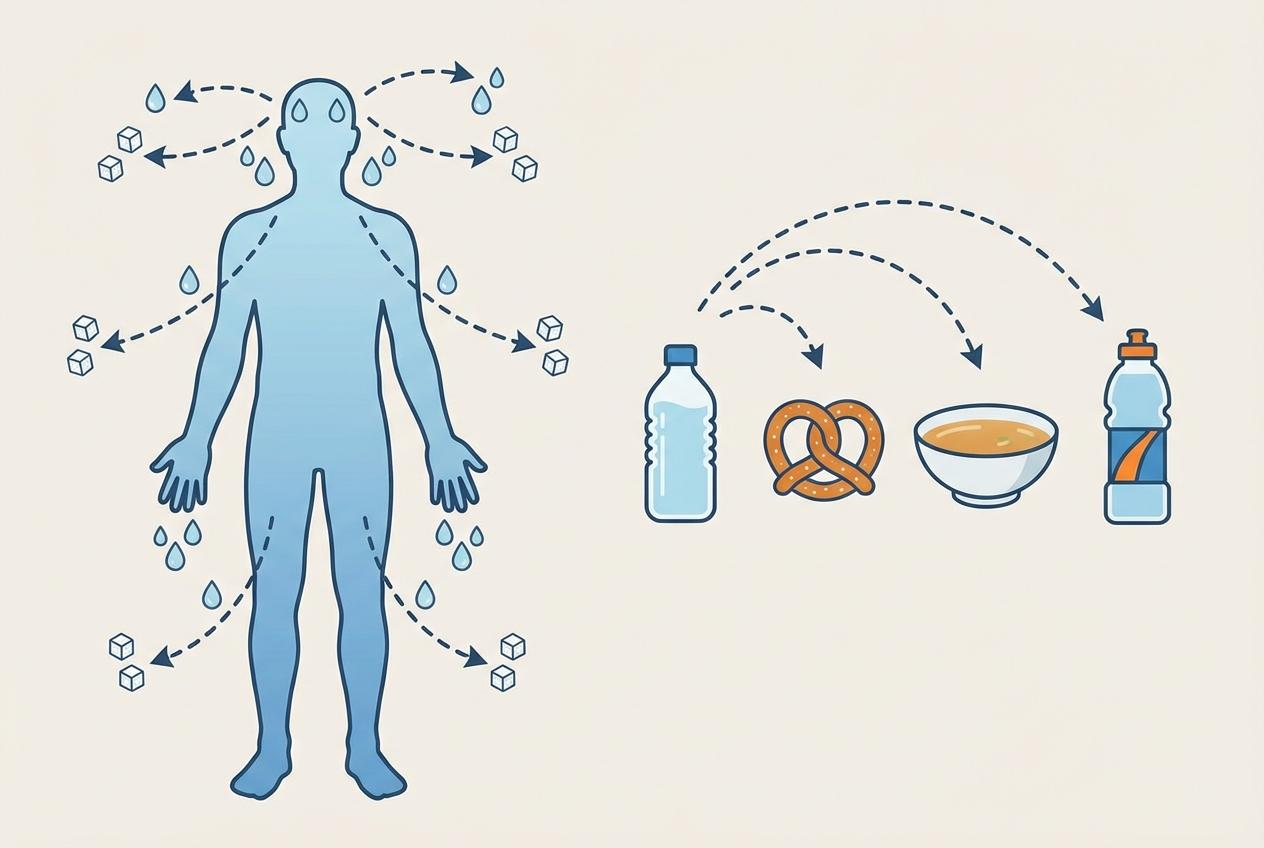
That rhythm stays steady—until your environment starts pulling water out of you faster than usual. A hard workout where you’re dripping, a hot office with blasting heat, or a long flight where the air feels dry can turn “I’m a little behind” into “water isn’t fixing this.”
In those moments, the issue is often more than volume. If you’re sweating a lot, you’re losing salt too. A common pattern: you drink plain water after a workout, but you still feel headachy, wiped out, or a little dizzy when you stand up. You might notice salt marks on your shirt or you’re craving something salty. That’s a cue to add fluids plus sodium—often as simple as water with a salty snack, a broth-based lunch, or a sports drink during longer sessions.
More fluid without enough salt can leave you peeing more without feeling better, but going hard on electrolytes “just in case” can upset your stomach or add a lot of sugar. That’s where packets can be useful—or become an expensive default.
Electrolyte packets: helpful tool or expensive habit?
That “just in case” packet is usually what people reach for when plain water still doesn’t change how they feel. Used that way—after a sweaty workout, on a long travel day, or when you’ve been in heat—electrolytes can be a simple fix because they add sodium back in, which helps your body hold onto the fluid you’re already drinking.
It becomes an expensive habit when it turns into your default, everyday solution. If you spend most of your day at a desk, eat regular meals, and your urine is consistently pale yellow, an electrolyte packet is unlikely to address the underlying issue. The real problem may be sleep deprivation, excessive caffeine intake, or skipping meals and mistaking it for a hydration fix. Many packets are sweetened, some contain high levels of sodium, and a few may cause digestive discomfort—especially if you start using more than recommended.
A clean test: keep packets for “high-loss” days only. If you need them daily to feel normal, that’s a signal to look beyond water and salt.
Your simple hydration plan (and when to stop blaming water)
When you “need them daily to feel normal,” the simplest move is to tighten the plan, then see what changes. Keep your three anchors (start work, after lunch, end of last meeting), plus one pre-call mini-drink for any meeting longer than 45 minutes. Use your cues to adjust: darker urine by mid-afternoon or a long stretch without peeing means add a small glass at the next anchor; frequent clear pee means back off and stop “catching up.”
Save electrolytes for high-loss days (hard sweat, heat, long flights) and pair them with real food when you can. If headaches, dizziness, or fatigue keep showing up after a week of a steadier rhythm—especially with decent sleep and regular meals—stop assuming it’s hydration and consider caffeine timing, eyestrain, allergies, or a check-in with a clinician.